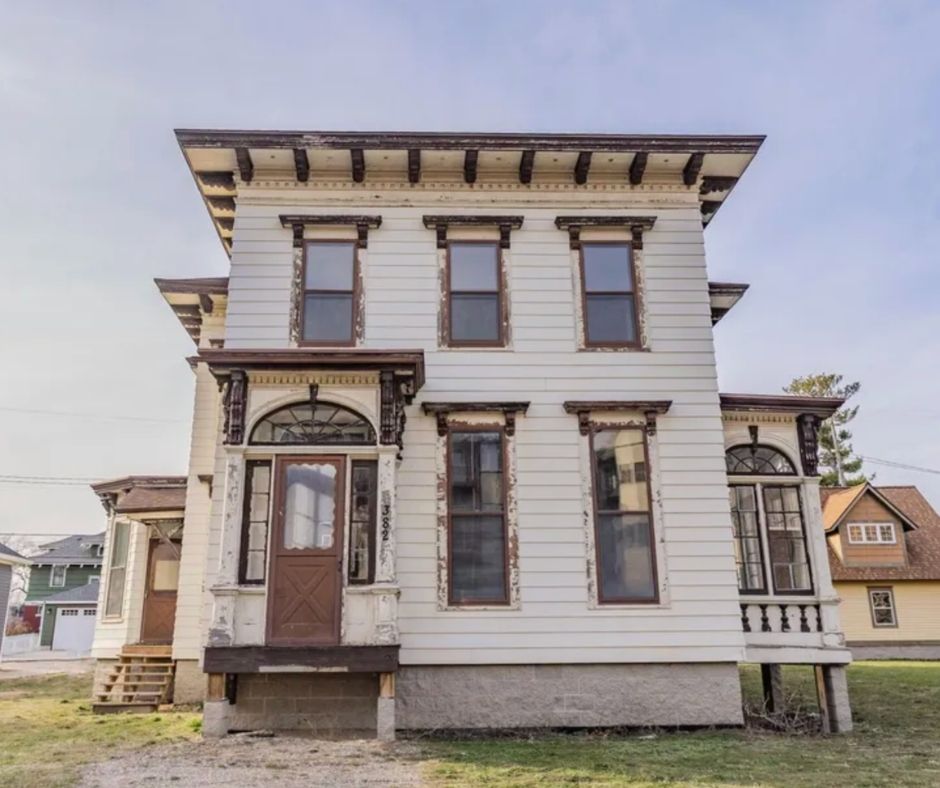
c.1869 Michigan Italianate Fixer Upper $150K
$150,000
A true piece of living history, this remarkable Michigan Italianate was originally commissioned circa 1869 for lumber baron Charles D. Nelson. Having journeyed across the city to preserve its legacy—first to accommodate the creation of the iconic Hackley Park and most recently in 2024—the home now rests on a brand-new, engineered footing and foundation.

Realtor Comments
- bed
- bath
- Circa 1869

382 W Muskegon Ave, Muskegon, MI 49440 $150,000
If interested in a property, please contact the realtor whose link is provided in the post below, or contact an agent of your own choosing. Independent verification of details and status is recommended.
Contact Realtor: Timothy Updyke

Pros of Living in Muskegon
Unrivaled Fresh Water Access: Muskegon is defined by its water. Residents have immediate access to Pere Marquette Beach, a sprawling white-sand beach on Lake Michigan that is consistently ranked among the best in the nation. With three major lakes (Muskegon, Bear, and Lake Michigan) and a deep-water port, it is a world-class hub for sailing, fishing, and boating.
Affordable “Coastline” Living: Compared to other Lake Michigan beach towns like Grand Haven or Traverse City, Muskegon is significantly more affordable. While home prices have risen (the median sale price hit approximately $253,000 in early 2026), it remains a rare location where you can find proximity to the water without the “resort town” price tag.
Cultural Renaissance: The downtown area has undergone a massive transformation. The Muskegon Museum of Art is world-renowned for its size, and the historic Frauenthal Center serves as a stunning venue for theater and the symphony. The city also hosts major events like the Muskegon Bike Time and the Unity Christian Music Festival.
Four-Season Recreation: Beyond the summer, Muskegon is a winter sports destination. The Muskegon Winter Sports Complex in Muskegon State Park features one of only four luge tracks in the United States, along with miles of lighted cross-country ski trails and ice skating through the woods.
Cons of Living in Muskegon
Crime and Safety Concerns: Statistics show that the city of Muskegon has higher-than-average rates of both property and violent crime compared to the Michigan state average. While many neighborhoods—particularly in the Lakeside and Glenside areas—are considered safe and quiet, other pockets of the city struggle with more visible poverty and crime issues.
Economic “Growth Pause”: As of early 2026, the local and state economies are experiencing a period of stabilization following years of rapid growth. While sectors like healthcare (Mercy Health) and aerospace manufacturing remain stable, the explosive hiring seen in previous years has cooled, making the job market more competitive for new arrivals.
Harsh, Lake-Effect Winters: Living on the lakeshore means dealing with “Lake Effect” snow. Muskegon frequently receives much higher snowfall totals than inland cities like Grand Rapids. The winters are long and can be quite gray, which may be a challenge for those not accustomed to the heavy overcast typical of West Michigan.
Industrial Footprint: While the city has moved toward tourism and tech, its industrial past is still visible. Some residents find the remaining manufacturing sites and port activity to be a detraction from the “beach town” aesthetic, though many see it as part of the city’s unique, blue-collar character.

History
The Nelson House was originally constructed at the northwest corner of Webster Avenue and Third Street by Charles D. Nelson (1824-1895), a lumber businessman who was also actively involved in serving the local community. He lived in the home with his wife, Carrie, and children, Jennie and Harley.
Nelson initially lived in the home before selling it to John Torrent, another prominent figure in the lumber industry who also served as an alderman and was elected mayor of Muskegon for three terms. Torrent later passed the house on to his daughter and son-in-law, who became its next residents.
Much of the surrounding land—about 2.3 acres that now form Hackley Park—was gradually acquired by lumber magnate Charles Hackley. At the time, several homes stood on that land.
Torrent’s property was the final one Hackley purchased. Because he held out the longest, Torrent received a significantly higher price than the other homeowners. The two men were not only businessmen but also competitors in the lumber industry.
In 1890, Hackley donated the land to the city, and the park remains one of several local landmarks bearing his name.
The mansion itself was later relocated to serve as the rectory for St. Jean Baptiste Catholic Church, which had been vacant. The move was carried out by placing the house on wooden logs and pulling it with horse teams. Situated at 1292 Jefferson Street, the building continued to function as a rectory until 2016. It was moved again to its current location in 2024.


 *
*