
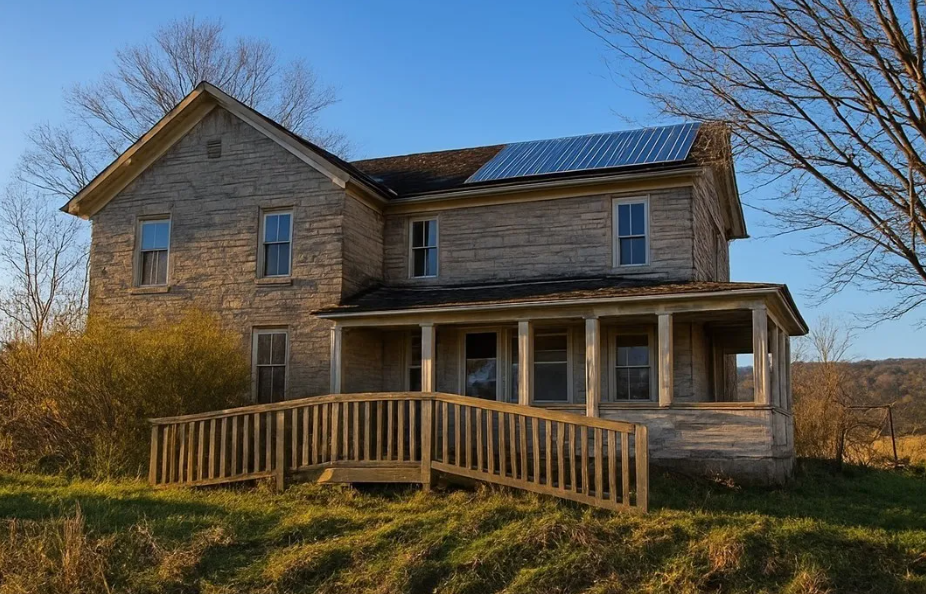
c.1900 New York Fixer Upper Farmhouse on 1 Acre in Beautiful Countryside Under $50K
OHU50K Notes $49,900

Realtor Comments
This house needs repair, with a little work, it could be a great family house. Lots of bedrooms for a large family and has a detached 2 car garage. Priced to sell.
- 6 bed
- 2 bath
- Build date 1900

- Contact Realtor: Roger McKee
- Google Map
- Niche


Pros of Living in McDonough, NY
Very Rural, Scenic / Natural Environment
McDonough is very rural — about 39 sq mi in area with a very low population density.
There’s lots of natural land: state forests, hills, and recreational terrain.
Outdoor recreation is a big plus: hiking, snowmobiling, hunting, fishing, and access to the Bowman Lake State Park.
Tight-Knit / Peaceful Community
With fewer than ~900 people (2010 census was 886) it’s a very small town — good for privacy, community, and a slower pace of life.
The town has a long history and a strong community ethic: its website emphasizes historic structures, local volunteerism, and preserved natural beauty.
The Calvary Church was converted into a library / community center, which shows local commitment to preserving heritage.
Relatively Affordable Housing (for New York)
According to Niche, median home value is around $121,400, which is much lower than typical NY housing prices.
City-Data also confirms low housing costs and a lower-than-average cost-of-living.
Many residents own their homes (Niche reports ~89% homeownership).
Low / Moderate Crime
According to CrimeGrade, violent crime grade is A.
The cost of crime per household is estimated to be $336 (CrimeGrade).
That makes it relatively safe compared to many places, especially for serious violent crime.
Access to Outdoor & Cultural Amenities
Besides the natural areas, the town is not super isolated: it’s within a reasonable distance of several larger towns / cities (e.g., Binghamton is ~32 miles away).
The town hosts a Buddhist retreat center (Palyul Ling) — that’s a pretty unique cultural / spiritual asset.
Strong “right to farm” protections, which supports agricultural or homesteading lifestyles.
Local Economy & Employment
According to the land-use (“UMP”) report, many people in McDonough likely work in nearby regional firms (e.g., in Chenango County), and a 30-minute commute is typical.
There are employers in the region (hospital, manufacturing, and education) that could support local work.
The town government is small and organized, which may mean more responsiveness in local decision-making.
Demographics & Population Stability
The median age is fairly high (City-Data reports ~46.7 years) which suggests a stable, possibly slower-paced community.
The 2023–2024 demographic data suggests only small population change, so if you don’t prioritize rapid growth, that may be a feature, not a bug.
Cons / Challenges of Living in McDonough, NY
Limited Economic Opportunity / Low Incomes
Median household income (per some sources) is relatively low. City-Data reports ~$52,616.
According to older census data (via Wikipedia), median household income was very low ($29,402 in 2000), though it may have improved; still, economic opportunity is more limited than in metro areas.
Educational attainment is somewhat low: per Homes.com, only ~14.7% of residents have a bachelor’s degree.
Aging / Small Population
The small population limits scale of services, retail, and infrastructure.
An older median age (per some sources ~53.4) suggests fewer young families or less workforce growth.
With a small population base, attracting new businesses or sustaining large economic development could be challenging.
Limited Amenities / Services
Because it’s rural, there are few (if any) major retailers or large medical centers directly in town. McDonough’s website emphasizes a few local businesses and much of daily life likely involves traveling to nearby towns.
Public transportation is likely minimal or non-existent, so car dependence is strong.
Crime Complexity
While violent crime is low (CrimeGrade), Niche / other sources report property crime rates (burglary, theft) that are not trivial.
Because crime data is limited and based on small population, “safety” can vary a lot in such a rural place — and crime “costs” per household may still be meaningful.
Long Commutes / Travel Time for Work
According to the local UMP (unit management plan), many residents travel to work in neighboring areas; mean commute times may be around 30 minutes for some.
Depending on where you work, that commute (plus car costs) can add up.
Aging Infrastructure / Limited Growth
Rural towns sometimes struggle with maintaining roads, public services, and infrastructure — especially if the tax base is small. (Inferred from rural nature and small population.)
Economic strategies may be limited: while there is “right to farm” protection and a draw for outdoor lifestyle, large-scale growth or industrial expansion is unlikely.



One Comment
Danielle
I would love this as I am looking for new properties to start to work on and be a first time fixer upper!