

Stunning Historic c.1899 Illinois Victorian Home For Sale on 0.71 Acre $165K
OHU50K Notes $165,000
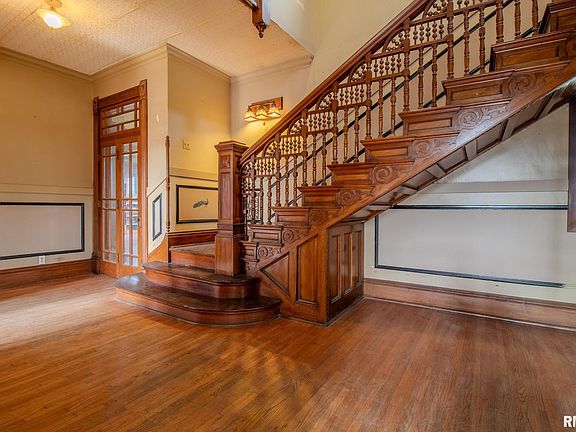
The craftsmanship of this Victorian home for sale is absolutely incredible. From the stick and ball fretwork on the staircase in the main entrance to the transom glass above beveled swinging doors this home has the true feel and style of the early twentieth century. Built-ins and original hardwood flooring run throughout.
Zillow Comments
Historic home in Downtown Marion! Merge that early 1900s feel with modern day functionality and efficiency. This home received a brand new roof in 2021 and new HVAC system in 2023 which included 2 high efficiency gas furnaces and 2 outside AC units. There is a covered front and back porch and sits on a double lot that offers plenty of yard space as well as a concrete parking pad, a block building for storage, and privacy fenced back yard. Schedule your private showing today!
- 4 bed
- 4 bath
- 3,470 sqft
- 0.71 acres
- Build date 1899
If interested in a property, please contact the realtor whose link is provided in the post below, or contact an agent of your own choosing. Independent verification of details and status is recommended.
904 W Cherry St, Marion, IL 62959 $165,000
- Contact Realtor: Dalton J Woolard Phone: 618-937-3040
- Google Map
- Niche
Family History
Excerpts from”
Marion Illinois History Preservation
Rufus Neely(1864- 1939) was one of Williamson County’s best known public men. He was married to Emma Harris of Carrier Mills March 20, 1888, and the young couple lived on a farm in the eastern part of Williamson County until December 10, 1900, when they moved to this home at 904/906 West Cherry Street in Marion.

The couple had four children, Horace, Ralph, John and Bertha.
After he and his wife moved to Marion. Rufus served as Deputy Circuit Clerk.
In 1902 he was elected County Judge of Williamson County. After serving two years on the bench, he resigned as judge and shortly thereafter was appointed by then Governor Charles S. Deneen as a member of the Board of Commissioners of the Southern Illinois Penitentiary at Chester, a post he held for eight years.
When the United States entered World War I, Rufus was named by President Wilson as a member of the Military Exemption Board for Williamson County; he served in that capacity until the end of the war.
Following his service as County Judge, Rufus was a participant in most of the criminal trials held in this county. He was one of a group of seven lawyers who represented the 12 “Herrin Massacre” defendants tried in two long, much publicized trials during 1922 and 1923.

*
Along with his legal practice, Rufus Neely was active in a number of business enterprises. He was one of the incorporators of a local newspaper and was president of the corporation which operated it for several years. He was also active in the organization of and as counsel for area banks operating during the period of his practice.
It is noteworthy that Rufus Neely had no law school degree, but this was no handicap to his legal career.
Emma Neely died August 12, 1929 in the home followed by Rufus Neely who died in the home May 23, 1933 at age 69. They remained in their home at 906 W. Cherry till their deaths.
*
Location of This Victorian Home For Sale
*
*
*
*
*
*
*
*
*
*
*
*
*
*
*
*
*
*
*
*
*
*
*
*
*
*
*
*
*
*
*
*
*
*
*
*
*
*
*
*
*
*


2 Comments
Lonn
Looking at the neighborhood, it’s easy to imagine an entire street with similar houses and children playing croquet in the front yard, ladies sipping a cup of tea in the kitchen, and the men smoking cherry-blend tobacco pipes in the parlor.
This house is a wonderful example of America of yester-year.
[email protected]
Love that picture!